How to Choose a Charging Cable for Android Phones
By MIZAZY · 15 November 2026
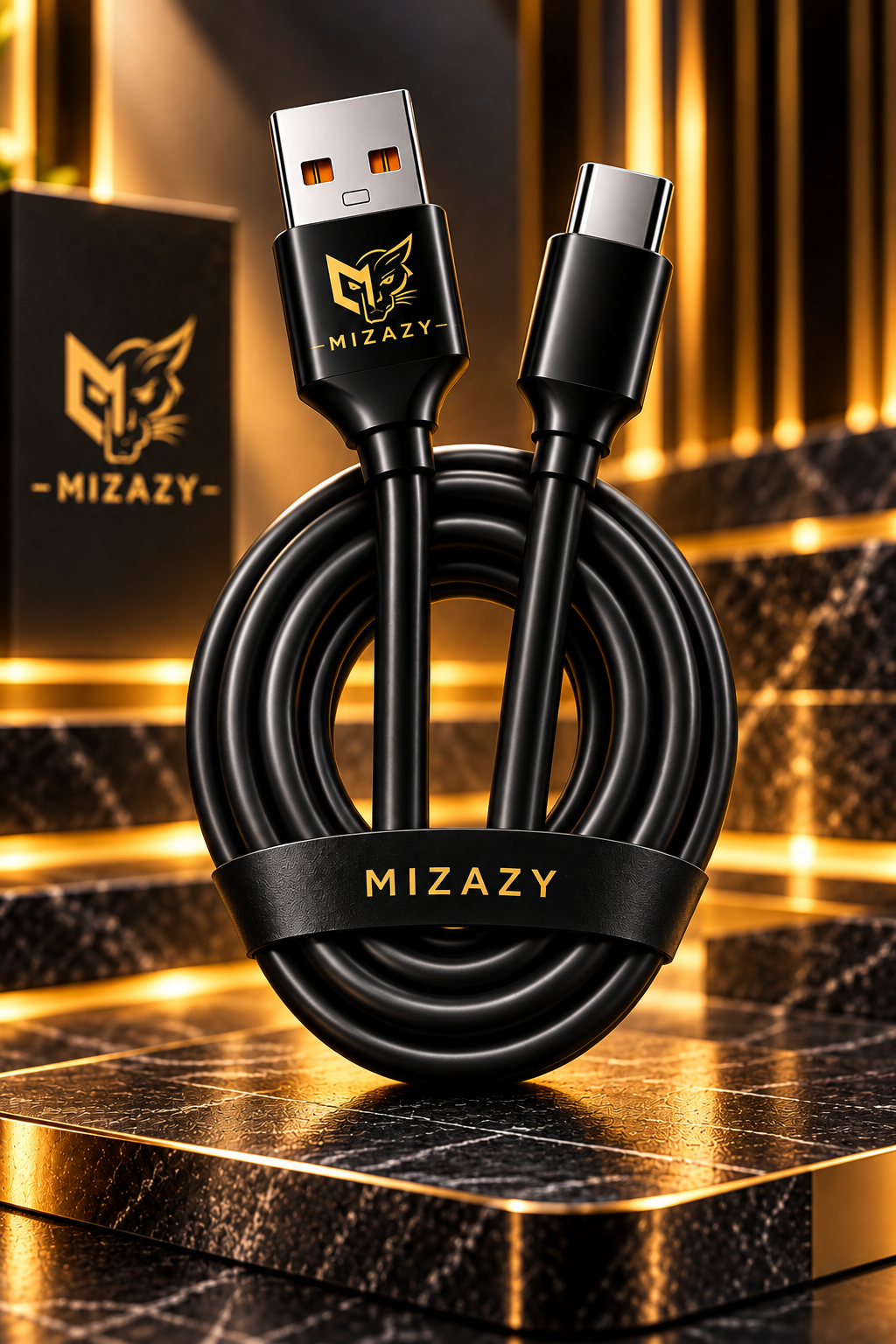
Data Cable
An Android Type-C charging cable fits the oval port on most phones sold in the last several years. Older Android phones used micro-USB. A few accessories still do. Look at the socket before you trust the word Android on a cable box.
Mizazy's 65W, 120W, and 140W cables are USB-A to Type-C. They are a match for a USB-C Android phone and a USB-A charger. They are not a match for every proprietary fast-charging scheme, and this guide will not claim that they are.
The connector on the phone
Current Android phones commonly use USB-C. That is the reversible oval plug. If your phone still has a micro-USB port, none of these three cables fit it. If the port is USB-C, the phone end of a Type-C charging cable is the right shape.
Shape is only the first check. Two USB-C phones can still negotiate charging differently. A cable that fits both does not make them charge at the same rate.
USB-A to Type-C versus other leads
A USB-A to Type-C cable joins a rectangular charger port to the phone. A USB-C to USB-C cable joins two oval ports. An Android data cable in the first group is what you want when the brick, power bank, or older laptop offers USB-A.
All three Mizazy listings are the first group. If your Android charger is USB-C only, these leads will not plug into it. Buy a USB-C to USB-C cable for that brick instead of forcing an adapter stack.
Wattage and what the phone will accept
The watts on the package are a maximum for the cable. The phone requests a level. The charger offers a level. The result is the lowest limit that still fits the protocol they share.
Printed ceilings here are 65W max, 120W max, and 140W with up to 3A on the 140W page. Each listing says the real rate depends on the charger, the device, and the charging technology. A phone that fast-charges at 18W or 25W does not become a 140W phone because the cable says 140W.
Data transfer, if you also copy files
Charging is the main job. Copying photos to a laptop is the second job, and it needs a data pair. Confirm the page says data sync before you rely on the lead for files.
The 65W cable lists USB 2.0 data sync. The 120W cable lists high-speed data sync without a megabit figure. The 140W cable lists up to 480Mbps. Those data lines are independent of the wattage. A higher charging number is not a faster copy.
Length and how the cable is built
A desk usually wants about a metre. A pocket wants less loose cable. Use a length the page prints, because a photo cannot show metres honestly.
The 120W and 140W pages list 1 metre. The 65W page does not publish a length. The 140W cable adds a nylon braid and reinforced connectors. The 120W cable lists a PVC jacket, metallic connectors, and a tangle-free design. The 65W cable lists a durable everyday build and does not list a braid. Pick the build that is written down.
When a braid is worth it
A braid resists abrasion from a bag. It does not add watts and it does not add a charging protocol. If your last cable failed at the plug, a reinforced connector line is the more relevant sentence than the wattage.
That reinforced-connector line is on the 140W page, with the tangle-free and knot-resistant note. The 120W page instead highlights over-current and over-voltage protection. Different durability notes, both worth reading, neither a substitute for the right port.
Fast charging support has limits
Phone makers use their own names for fast charging. A cable can be electrically capable and still leave a phone on a basic rate if the charger and the phone do not share a scheme. Do not assume a USB-A to Type-C lead enables every brand's top speed.
Mizazy's cable pages claim compatibility with the ports they name: Type-C devices, and on the 120W page smartphones, tablets, and laptops where the USB-A and Type-C ports match. They do not claim every Android phone or every proprietary protocol. If your phone only hits its advertised speed with the manufacturer's own charger, a replacement lead may charge it at a lower rate.
Mistakes that show up after delivery
Ordering a USB-A cable for a USB-C charger. Expecting 120W or 140W from a phone that never asks for it. Using a charge-only lead and then blaming the phone when the computer cannot see the files.
Another miss is ignoring length because all cables look long in a product photo. If you need a stated 1 metre lead, use the 120W or 140W page. Leave the 65W length unmarked rather than guessed.
Buying checklist
Check the phone, then the brick, then the printed lines.
- The phone port is USB-C, not micro-USB or Lightning.
- The charger port is USB-A. These three cables are USB-A to Type-C.
- You have read 65W, 120W, or 140W as a ceiling the phone can undercut.
- You are not assuming a proprietary Android fast-charge mode the cable page does not name.
- Data wording matches your file copies: USB 2.0, high-speed sync, or up to 480Mbps.
- Length is published if you need it. 120W and 140W list 1 metre.
Conclusion
For a USB-C Android phone and a USB-A charger, a USB-A to Type-C cable is the lead to shop. Mizazy's 65W, 120W, and 140W pages give you three sets of published limits: wattage ceilings, data wording, and, on two of them, a 1 metre length.
Stop at those limits. The data cable category is where the three pages live. None of them is a universal Android charger.
Questions
Will these cables fast-charge every Android phone at the printed wattage?
No. The wattage is a listed maximum. The phone, charger, and charging protocol set the rate, and these pages do not claim every proprietary Android protocol.
Do I need this cable if my Android charger is USB-C only?
No. These Mizazy cables are USB-A on the charger end. A USB-C-only brick needs a USB-C to USB-C cable.
Which of the three lists a nylon braid?
The 140W cable. The 120W cable lists a PVC jacket. The 65W cable does not list a braid.