What Does 480Mbps Mean in a Data Cable?
By MIZAZY · 15 November 2026
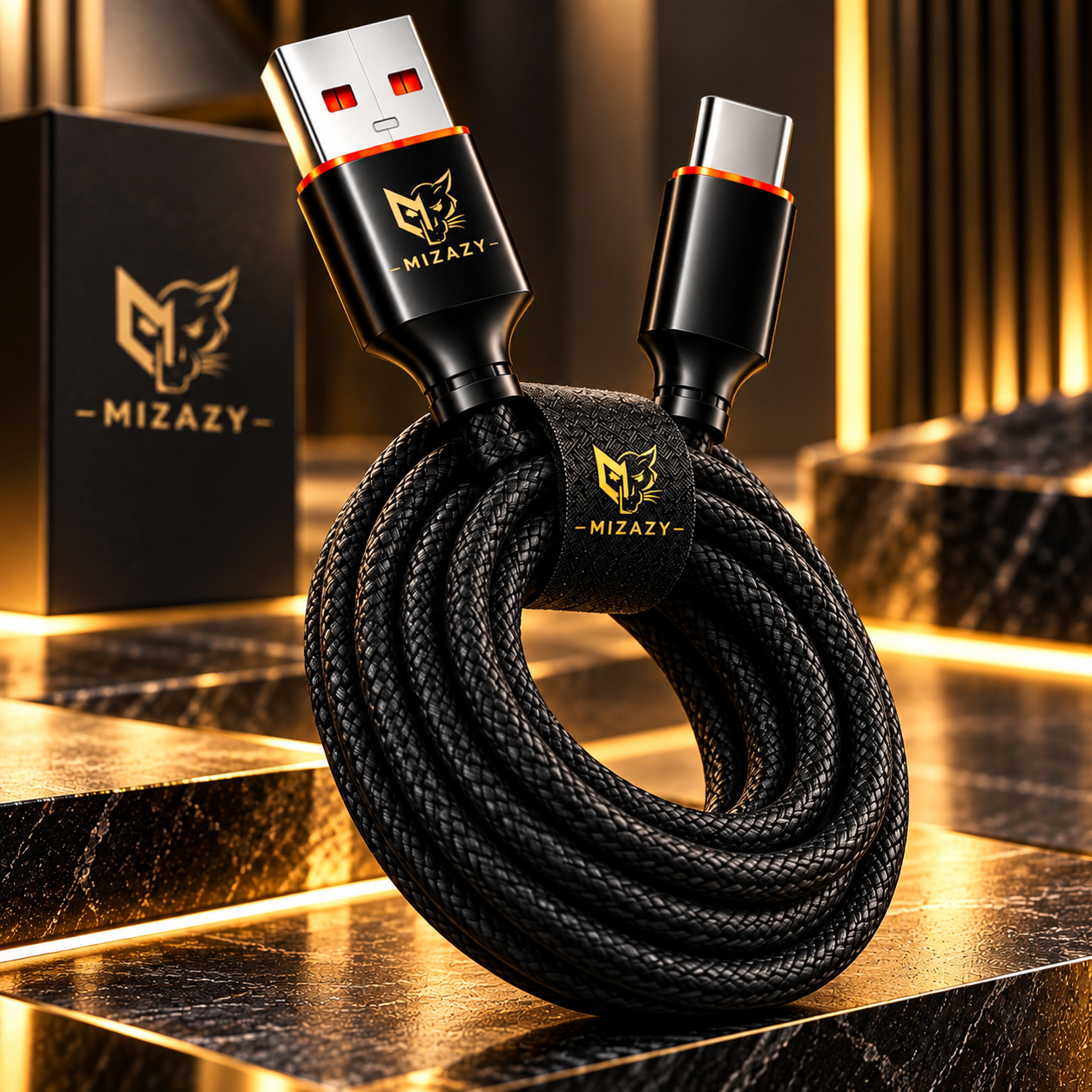
Data Cable
480Mbps on a data cable is a rate: 480 megabits per second. It describes how fast data can move in the best case the listing allows. It is not a promise that every file copies at that rate from the first second to the last.
The Mizazy 140W Fast Charging Data Cable is the Mizazy listing that prints it. The page says USB-A to Type-C, 1 metre, nylon braided, and up to 480Mbps. The words "up to" are part of the specification.
What Mbps means
Mbps stands for megabits per second. A bit is the smallest unit in this count. A megabit is one million bits. The rate is a flow, like litres per minute, not a file size.
A 480Mbps data cable is therefore a cable whose listed data ceiling is 480 megabits each second. Data cable speed on a package is that ceiling. Your computer still has to keep up.
Where the number 480 comes from
480 megabits per second is the maximum signalling rate people associate with USB 2.0. You will see it quoted as the USB 2.0 transfer speed. Quoting the standard is not the same as measuring a particular laptop port.
The 140W Mizazy page lists up to 480Mbps and does not label the cable "USB 2.0" in those words. A different Mizazy cable, the 65W, does label USB 2.0 and does not print 480Mbps. Keep each page's wording. The link between the standard and the number is background, not a rewrite of either listing.
Bits are not bytes
File sizes on a phone are usually shown in megabytes or gigabytes. A byte is 8 bits. Divide megabits by 8 to talk about megabytes. 480 megabits per second is 60 megabytes per second, before any overhead.
Overhead is protocol cost, not a rounding error you can ignore. A real copy lands below that 60 megabyte figure even when the link is healthy. If a shop treats 480Mbps as 480 megabytes per second, it has inflated the rate eightfold.
The USB standard sets the ceiling
The cable, the phone port, and the computer port have to share a mode. A faster standard on one end does not lift a slower port on the other. The link runs at a rate they can all do.
That is why a Type-C data cable with a high charging wattage can still list a USB 2.0-class data ceiling. Charging watts and USB data transfer are different lines. On this cable the charging line is 140W and up to 3A. The data line is up to 480Mbps.
Charging speed is not this number
Nothing about 480Mbps tells the phone how many watts to draw. You can copy files slowly over a cable that charges quickly, or charge modestly over a cable with a clear data rate. Read both.
The 140W rating will not turn a 480Mbps transfer into a faster one. It also will not make every phone charge at 140W. The product page says charging speed depends on the charger, the device, and the protocol.
Why the speed you see will vary
The phone may be busy. The computer port may be sharing a hub. The drive you are copying to may be the slow part. Small files add extra work per file, so a folder of tiny photos often runs below a single large video.
The Mizazy page says actual data transfer speed depends on the connected device, the port, storage, and other hardware and software conditions. That sentence is the right companion to "up to 480Mbps". This guide does not promise a constant 480Mbps copy.
Device and port compatibility
This cable is USB-A on one end and Type-C on the other. The computer or charger needs USB-A. The phone needs USB-C. A USB-C-only laptop port needs a different cable, even if you liked the 480Mbps line.
The page also lists a 1 metre nylon braid, reinforced connectors, and a tangle-free, knot-resistant build. Those are handling details. They do not raise the data ceiling past the rate the ports negotiate.
How this helps you choose a cable
If you need a published data ceiling, the 140W listing gives you one: up to 480Mbps. If another cable only says "high-speed" or names USB 2.0 without a megabit figure, do not pretend it printed 480. Compare the sentences that exist.
The data cable category includes this 140W lead next to the 65W and 120W leads, which describe data differently. Use the 480Mbps article when the rate is the question, and the USB 2.0 article when the standard name is the question.
Questions about the rate
The answers below are the conversions and limits that stop the number being misread.
Conclusion
480Mbps means a listed ceiling of 480 megabits per second, about 60 megabytes per second before overhead. On the Mizazy 140W cable it is printed as up to 480Mbps, beside USB-A to Type-C, a 1 metre nylon braid, and a separate 140W charging line.
Expect real USB data transfer to move with the devices on either end. The listing already says so.
Questions
Will every file copy at 480Mbps?
No. The 140W page lists up to 480Mbps and says the actual speed depends on the devices, ports, storage, and conditions.
Is 480Mbps the same as 480 megabytes per second?
No. Mbps counts bits. A byte is 8 bits, so 480 megabits per second is 60 megabytes per second before protocol overhead.
Does the 140W charging figure change the data rate?
No. Charging wattage and the data ceiling are separate lines on the product page.